Showing posts with label beijing. Show all posts

Friday, June 18, 2010

Window to a Wall

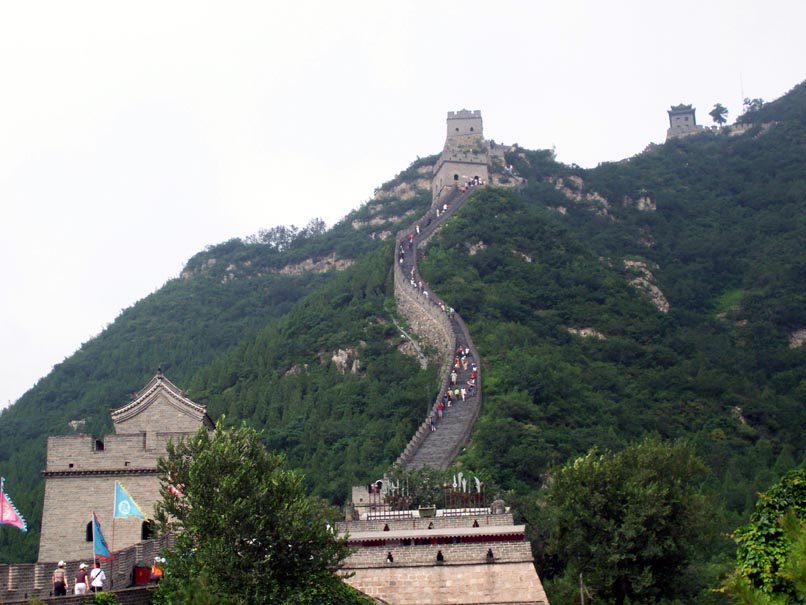
My favorite part of my first trip to the Great Wall was the quiet--once I got past the third signal tower at Mutianyu, the crowd thinned out. The cool wind blowing through the mountains was a welcome relief from the choking heat and humidity of Beijing in August.

Inside the signal towers, I let my sweaty shirt dry as I caught my breath. And during those breaks I was able to meet a few friendly Mainland tourists who spoke just enough English to match my Chinese ability at the time. It was a more difficult hike, but much more enjoyable than the following year when I visited the Badaling tourist trap.

Saturday, June 20, 2009

Heavenly Sight


The Temple of Heaven is my favorite tourist site in Beijing--probably because it's the only place I didn't get excessively harassed by hawkers selling all sorts of cheap souvenirs at inflated prices that I could buy just about anywhere in China. It also helps that the two times I visited the Temple of Heaven the weather was great, albeit extremely hot (the sky was even blue the second time around). And the massive park surrounding the main structures never felt crowded, though I'm sure there were plenty of people spread out around the place.

Wednesday, July 30, 2008

Surprised?

I'm amazed at the reactions I've read about Internet access as it relates to journalists during the Olympics. Everyone is shocked that China will not provide complete, unfiltered access. Of course the government doesn't want reporters doing research for politically sensitive topics during August. And I'm sure that all the volunteers in the Olympic Media Village will be monitoring every computer for poxy servers and other undesirable material (careful, don't surf for porn on Chinese government computers).

The bigger story is that the harmonized access to the Internet will be expensive. According to Andrew Lih and Slashdot, Beijing is charging US$1131.20 for Internet access in the Olympic Media Village. That fee is for one month of Internet access. To put this in perspective, I pay about 700 RMB for six months of harmonized access to the Web. At this time the exchange rate is approximately 6.8 RMB to $1; you do the math.

And then there is US Senator Sam Brownback, who is berating China over its alleged attempts at spying on foreign guests in hotels. Does Sen. Brownback think that tourists are carrying state secrets to China during the Olympics? How does the Senator feel about my own government listening in on my weekly phone calls with my parents? I bet Homeland Security is bored every time they listen in.

Sen. Brownback, have you met Mr. Kettle?

Monday, July 21, 2008

Olympic Fighting Words

From the official Olympic Security English handbook comes a lesson on "Frighting." That is not a typo, they actually have two lessons for frighting. Oddly enough, the scenario appears to involve a fight and not a fright. In lesson 13 (pages 143-48), the scene is set up as an interrogation into the cause of a bar fight (there is no lesson on breaking up a fight or calming a situation that could lead to one). This is the lesson of "Frighting (1)" which I had to teach to the class of police. I had to alter it significantly so it would be useful for future reference.

Police: You've hit and injured another person, you know.
Foreigner: He's also hit and injured me.
Police: He's been injured very seriously and taken to the hospital.
Foreigner: It's unfair! Why are you only questioning me?
Police: We'll question him when he comes to.... How did you come to fight with him?
Foreigner: I couldn't bear his insult!
...
Police: Why did you fight with him this time?
Foreigner: Because he took too many liberties with my girl friend.
Police: Did you try to keep away from him?
Foreigner: Yes. At first, we kept away from him, but not very far.
Police: Why didn't you leave the bar?
Foreigner: Who could tell that he was so impudent? Not long afterwards, he came close to my girl friend and held her in his arms!
Police: Did your girl friend resist him?
Foreigner: Of course she did. She tried hard to push him away. But he was very rude to her. He even kissed her by force. What a rascal!
Police: Did you try to stop him?
Foreigner: Yes, I did. I tried to push him aside.
Police: Did you succeed?
Foreigner: No. On the contrary, he hit me in the face with his fist.
Police: Why didn't you call the police at once?
Foreigner: I was very angry. How could I stand such an insult? I hit him on the head with a bottle.
Police: As a result, you wounded his head.

The conversation continues with some boring details after this point. What I'd like to know is, who actually speaks like this? I told the class that no one would ever use the word rascal, but if they did find someone who said this they were to contact me immediately so I could meet this person.

Read part 1 and part 2 of this series.

Saturday, July 19, 2008

Really Overreacting?

Over the past few weeks, everyone has commented on the seemingly paranoid response by the Chinese government to ensuring a safe Olympics. The Financial Times published an article titled "Threat of 'no-fun' Olympics" with former Olympic marketer Michael Payne stressing that China needs to have a festival atmosphere and "smile" more.

There is ample evidence of over-planning in Beijing. The enforcement of old and new rules for obtain visas, as well as the difficulty for some to even stay in the country for the summer, has certainly cut down on some of the fun around the country. This goes with Beijing's decision to close entertainment venues by 2 am (and I thought the bars never closed), and putting restrictions on outdoor seating for restaurants, bars, and barbecues. Some of the biggest stories of paranoia deal with the threat of terrorism during the games. Beijing has sent out the comically-equipped Segway paramilitary and deployed anti-aircraft missiles outside the Bird's Nest.

Is this really just paranoia on the part of Beijing? I'd say, in some ways it is--the government is afraid of losing face in the event that anything doesn't go as planned. However, much of the preparation is more a sign of the times. As disturbing as it sounds, there are quite a few people in the world who don't care about the Olympic tradition of peace and ceasefire. Unfortunately, this is how some people act.

The Olympics is the world's greatest stage. One can make a huge political statement, even if the outcome isn't entirely successful. Personally, I have no problem with people using this time to make a peaceful political statement on the world stage. But, there is a line that too many are willing to cross for their message. The hope is that Beijing will be able to tell the difference between these groups and act accordingly.

Friday, June 20, 2008

Fueling Change

Thursday, Beijing announced a 17% rise in fuel costs for private cars (12 cents per liter), 18% increase for diesel, and 25% increase for jet fuel. There will also be an increase in electricity prices. Most people were expecting that the cheap gas (approx. $2.50/gallon) would last until after the Olympics. Beijing decided that the price increase would take effect midnight Friday, which caused long lines at gas stations across the country of drivers trying to save money. The government will also offer subsidies to some industries affected by the new policy (i.e. taxis, buses, grain producers).

This is certainly a good move by the Chinese government. Gas prices are extremely cheap here. The people who own cars tend to be the wealthy elite of the country who could afford an increase in costs. With any luck, this price hike will change some driving habits. If those habits change, the air quality in and around Beijing may improve slightly prior to the opening of the Olympics. This will also help ease the strain on supply here in Shenzhen as many Hong Kong drivers have been crossing the border to the Mainland to fill up on cheap gas.

This move comes on the heels of the plastic bag ban from June 1. If these policies hold, China will be making great strides toward improving the environment. The international community will have to wait and see what further moves Beijing makes for benefit of everyone.

However, not everyone is pleased with this decision. Many Chinese citizens believe that this move by the government will seriously harm many industries, thus destroying the national economy. Personally, I have seen a lot of waste in business (i.e. opening windows and doors with air conditioning running on high) , and believe that this should change many habits that will improve business in China.

Digg!

Friday, April 18, 2008

Views on a Friday

I'd like to share a story from my trip to Jiuzhaigou in the Tibetan region of Sichuan province. On our first day through the park, we spoke with college student who was home for the holiday. She was very honest with us about the villages in the area. She said that since 1986, the park opened, the village became increasingly wealthy. Most of the people were happy to use the money to send their children to the cities to get a better education. The only downside that she saw from the changes was that the government banned livestock (sheep and yak) in order to protect the area, thus completely shifting their means of living. She didn't see all of this as being government repression, but she did see some of the traditions of her people fading.

Today, one of my students asked about the whole problem between Western media and China. He's not the best spoken student I have (I'd probably place him in the middle of my 300), but he managed to get his point across. Unlike the nationalist comments I've read online or heard about from friends, this question was rather simple yet thoughtful.

He, more or less, asked, "Why do the newspapers in France and Germany hate China and the Olympics?" At first I responded that it was too complicated to answer it in a short time. After class I tried giving a small answer. "I think part of it is a cultural miscommunication on both sides," I said. He agreed. I then explained that part of the problem was that the Chinese government restricts journalists from doing their job the way they should. Therefore, many journalists will write negative stories and ignore the positive as a way of responding to the restrictions.

I'm not entirely sure if he understood that mentality, but he listened for the point of view and passed no judgment on the answer. I'm sure if I gave this answer to some students that they'd be upset and get defensive in some way. Having students like this one makes me feel much better about my job.

After this short exchange he asked if I was going to Beijing for the Olympics. I answered, "Hell, no." He thought it was because of the crowds, but I gave him other reasons why I don't like the city that much. He agreed with me. "I don't think Beijing people are friendly," he said, "I like western China much more." I told him I thought the places I've been in the west were also friendlier than Beijing--Sichuan and Xinjiang have had some of the nicest people I've met in China.

Digg!

Sunday, September 16, 2007

Hutong Wandering

The following is an installment from the summer journey.

A while back, my parents mailed a short article to me (they often send news clippings about travel in Asia and events back home). This particular article was about side streets in Beijing--I found it just before moving and traveling to Beijing to meet my parents and brother. I figured it'd provide at least a few hours of something different from the previous year's trip through the capital.

I studied my map and found that the street in the article (Nan Luoguxiang) was not too far from the Drum and Bell Towers--it turned out to be about a 15-minute walk east along the main street. It sounded like there was enough to check out for the afternoon--it was either try this or find a taxi to somewhere else. We were pleasantly surprised.

Nan Luoguxiang is a quiet hutong neighborhood in the process of remodeling that is home to quite a few small bars, restaurants, and arts shops that are difficult to find elsewhere in the city. We discovered a small foot massage parlor (38RMB for one hour) and let my mom and brother take up the two available spots. My father and I walked along the street to find a snack and settled on the Pass By. There are two along the street and we chose the one further from the main road. They actually served spring rolls (anyone who lives in China knows that these are a rarity). There's also a great "hutong pizza," which is cheese covering spicy chunks of barbecued lamb.

The artistic shops have quite a few unique items. There are a couple of really nice T-shirt shops, but the prices are set and they are in the range of what you'd expect to pay in the U.S. My favorite shop was Grifted. They had some amusing shirts and other items. I ended up with a waving Chairman Mao doll and Jia got a shirt with a cartoon of Buddha looking like a tourist. They also had a shirt with a cartoon Chinese guy, shirtless with a beer and yelling "Ni hao!" Next to the shop was a small photo gallery chronicling the progress of reconstructing the neighborhood--the photos were beautiful.

On a few nights we stopped in the bars. These places are mostly small and quiet. We found the newly-opened Catcher in the Rye and we were the only customers. For those seeking a cheap night out, there's always the 10 RMB Bar--and there are others that have similar prices. Most bars have a decent selection of imported beers for travelers who are tired of Tsingtao (it was really nice to have a Newcastle).

At the moment, this narrow hutong street is fairly unknown to tourists, although it is getting more press and will probably be quite crowded by the time the Olympics arrive. So far, there is no Starbucks located there, but you can buy coffee at the restaurants and bars. After two trips through Beijing, I have to say that this is my favorite part of the city.

Digg!

Wednesday, August 01, 2007

More of the Wall

First I'll apologize for the layout of this post. Due to the censoring of Blogger by the Great Firewall of China, it's difficult to format photos and text to make posts aesthetically pleasing. Now, on with the post.

Last year we took our trip to the Great Wall at Mutianyu. This year I chose to hike Badaling even though it is the most tourist-traveled section. I decided this would be best for my parents because it would be easier to walk. It was certainly easier than Mutianyu, but it wasn't all that easy--especially once you get past the hordes of people. (Last year's Wall hike)


It was a long line just to get onto the wall--we probably waited about 15 minutes to get tickets and another 15 to get through the gate. But we pushed our way forward. We stared to the right and saw swarms of tourists flooding the way. It didn't look like the previous year with the crowds turning back after the third tower; these people kept going (take a close look at the photo above for proof). Obviously, we decided to head south instead. It was still crowded to the south, but the crowd broke much sooner than the north way.

The day was good--not too hazy and not too hot. My brother and I split from our parents so that we could go at our own pace. We allotted almost three hours to the hike. We managed to go as far as the government allowed:


We took a long rest at this point. The strangest moment came as we rested--a vendor scaled the wall and produced some cheap merchandise. We have no idea where he came from--it was almost a straight drop down the mountain on any side. How did this man get over the wall? Apparently, the Great Wall could keep invading Mongols out but it is no protection from a motivated Chinese vendor.


On our walk back through the parking lot/tourist trap village, we were harassed to no end by the hundred vendors all selling the exact same merchandise. I got fed up and lectured one vendor about why I refused to buy anything from him--I just don't like being begged to buy things I'm not interested in; if I want to buy something, I'll ask about it.


On the way back into the city, we asked the driver to drop us at the Lama Temple. My parents and I visited this amazing temple last summer, but we decided to see it again with my brother. It was well worth the extra visit and it was surprisingly uncrowded.

Digg!

Tuesday, July 31, 2007

Beijing Travels and other stuff

First the other stuff: We had dinner with Winnipeg over the weekend at the Xinjiang restaurant. The entire staff changed since I left for vacation. On the plus side, they hired a waitress who speaks English fairly well. They also now have an English menu... that was taken from a similar restaurant in Shanghai. Unfortunately, they didn't have any Black Beer that night.

Today, I met my Aussie friend for coffee. I found out he moved somewhere even more convenient (albeit further away); he's now just a few blocks away from Jia's office. So, after coffee, we headed out to meet my wife for lunch at Hasio (damn fine noodles for 10 kuai). Anyway, he seems to be doing quite well with work as he's not working too much and making quite a decent living.

On to travels in Beijing: I'll start off by saying I'm not a big fan of the city--it's very crowded and the vendors and rickshaw drivers get rather bothersome (they don't give up even after hearing "no" ten times). But this year I did find some things to enjoy.


On the first full day, we went to Tiananmen Square. We took a walk through Zhengyangmen (the gate on the southern end of the square). This was closed for renovation last year. It's a beautiful site with some great views of the square, Mao-soleum, and surrounding area. We were a little disappointed that the Mao-soleum was closed for renovation this year (we skipped it last year due to long lines); I'm not sure if they were renovating the building or the corpse, but it'll supposedly re-open in September or so.


We found a very nice tourist street that ran from the road near the Bell Tower to Houhai. We were very happy that the vendors on this street were pleasant and didn't harass us to buy everything. I bought a small propaganda poster for 5 kuai after a lot of bargaining in Chinese. Of course, I managed to lose it somewhere between Urumqi and Beijing. There were quite a few bars along the street (not Houhai) that my brother and I wanted to revisit one night, but we never made it back.

I discovered a few things about the Beijing taxis on this trip. This year they managed to find the hotel (maybe it was because I told them where the subway station was first). The drivers also seemed more friendly and less inclined to take us for the roundabout ride. I was thinking it may be one of those Olympic preparations, but who really cares when you have pleasant taxi drivers (that applies to anywhere in the world). We even had one on the way back from White Cloud Temple who didn't want to take us all the way back to the hotel and talked us into being dropped off at the nearest subway station (ended up as a cheaper trip). The taxis are also a bit cheaper than here in Shenzhen--Beijing starts at 10 kuai and it's 2 kuai per kilometer; Shenzhen starts 12.50 and it's 2.4 per kilometer. That's a big difference when you consider how huge a space Shenzhen takes up.

Tuesday, July 24, 2007

Beginning the travels

Before I start my story of the journey, I want to write about something a little strange that happened today. I found that I had a poem published. I submitted the poem more than a year ago and it was just published. But I never received any correspondence informing me of such. I'm still quite happy about this, just a little confused.

Anyway, the day before I left for Beijing to meet my family, I had to finish moving some of my stuff into a friend's apartment for storage (thanks again for that). The last piece I moved was my giant inflatable Kingway beer bottle. This was a fun journey through the neighborhood--everyone was screaming, "Da pijiu!" (Big beer). The best was the little boy by the dumpling shop who shouted, "Mom, mom, look! A foreigner. He has a big beer!" I almost fell over laughing--sometimes I wonder how good my Chinese skills are when that's the sentence I can translate.

My journey began the following day with catching an early bus to the airport. I waited. And waited. It was about 45 minutes of standing by the highway, waiting for one of two buses. Finally, I decided to see if I could find another bus to take me. One pulled up and I asked the ticket girl if the bus went to the airport and she hurriedly waved me aboard. I took my seat and she came by again to sell me a ticket. "Ni qu na li?" (Where are you going?") "Ji chang." ("airport"). She looked confused. I repeated my destination and included the name of the airport. She then told me they didn't go there. They stopped the bus at another bus stop down the highway to let me off as I yelled at the ticket girl for not listening to my earlier question. Fortunately, one of the buses I wanted just happened to be a short distance behind.

My flight left Shenzhen late. I didn't mind much as I was set to arrive an hour before my family and they would have to go through customs. What I didn't realize was that my flight arrived at the other terminal. So, I took my luggage on a nice long walk through the crowded Beijing airport. As I approached the Starbucks (no, I don't like their coffee, it's just a convenient meeting place), I ran into my parents and brother--they were early. Perfect timing.

We somehow managed to fit all our luggage into one taxi (better than paying 450 kuai for a van). The driver took us to the Harmony Hotel, right near the train station. Slight problem there, China International Travel Service never sent our reservation to the hotel even though my father pre-paid online. We got in a fight on the phone with them--they denied ever doing anything wrong (just wait til they have to deal with a credit card company that won't pay up). Fortunately, the Harmony Hotel did have two rooms for us for one night--we'd just have to find somewhere else for the rest of our time. It was disappointing, it was a nice hotel with cheap prices. We ended up at the Novotel by Chongwenmen subway station (same place we stayed last year). We had everything set for time in Beijing, except for our plans of what to do.

That night, I went out with my brother for some beer near the hotel. There were no bars, just restaurants. I was quite shocked when I saw our bill. The waiter said, "6 kuai." I thought he meant each, but it was the total. I couldn't believe the beer was that cheap.

Friday, December 15, 2006

Hiking the Wall

We began the day at a section of the Great Wall to the west of Beijing. It was far enough out of the way from the Badaling section that it wasn’t crowded, but it was still touristy enough to be well kept over the years.

Our sorry excuse for a tour guide told us that we’d have ample time to climb the wall and capture the views. An hour and a half was what she gave us. I began thinking it would’ve been better if my parents and I had taken the city bus to walk the Wall ourselves--we would’ve learned just as much history from a travel office brochure as the girl speaking Chinglish gave us.

Mom and Dad didn’t look pleased staring up at the steep steps of the Wall. I knew they wouldn’t make it far before turning back. I took the bare necessities (my camera and wallet) and sped off ahead of the group. Unfortunately, I left behind my water bottle with my parents. That mistake cost me six kuai about half and hour later.

At the third tower along the Wall was a shop that sold certificates stating, “I climbed the Great Wall,” and an engraved name and date for about 80 kuai. It seemed that almost everyone stopped here for a breather and to head back down the mountain. I gazed up toward the peak and noticed the crowd dwindle with each step--that was where I wanted to be.

At the fifth tower, I was sweating profusely and a cool breeze was blowing past me. I stopped to re-hydrate with an over-priced bottle of water. I conversed with a European couple attempting to purchase a T-shirt. The gentleman didn’t realize that Chinese sizes run much larger. I explained that in the U.S. I wore a medium size, but in China my size ranged from XXL to XXXL. They laughed and purchased their enormous, foreign-sized souvenir shirt, thanked me for my help, and headed back down the steps.

At the sixth tower, I was exhausted. I met a nice university student from Fujian Province with limited English skills to match my Chinese. He graciously took a photo for me and I returned the favor. I was tempted to head back in exhaustion, but the student coaxed me into going further with him and his companions.

I took another short break at the seventh tower and began climbing to the eighth—the last tower I was convinced I would make considering it was at the peak. After a couple steps up, I glanced at my watch. I had only a half hour to make my way back down the mountain. I grudgingly turned back and hurried my steps.

Back at the second tower, I was confronted by an older Indian tourist who asked, "How much further is it?" "Depends how far you want to go," I responded. His son found this answer much more amusing than he did. I elaborated, "Well, most people buy their souvenirs and head back after the next tower. But I made my way up to the seventh." The older man didn’t appear to want to trek that far up the mountain.

I arrived at the bus just in time for our scheduled departure only to discover that we would be delayed by another half hour--enough time for me to have gone all the way to that elusive eighth tower.

Sunday, August 20, 2006

Still Forbidden

Beijing's Forbidden City is still forbidden. Thanks in large part to the upcoming Summer Olympics in 2008, the major attractions are closed to the public. Everything that a tourist would possibly want to see there is shrouded by scaffolding--this includes the Palace Museum, which is quite possibly the most recognizable structure in all of Beijing.
It's not all bad news though. With the closing of the great spaces of tourism, the public is able to view other buildings within the walls of the Forbidden City that they would not otherwise wander upon. Of course, these buildings hold nothing of importance and have locked doors. They are also the structures that are in dire need of repair.
With the immense crowd of tourists wandering the grounds and the excessive heat of the Chinese summer, the Forbidden City became a waste of time and energy. Seeing as I don't plan to travel back to Beijing, as I feel it is the city with the rudest population in all of China, I was quite disappointed with the opening of my summer travel experience. As would later discover, the Forbidden City is not the only major tourist attraction that is being renovated--the Summer Palace, Temple of Heaven, Beihai, hutong neighborhoods, and other sites were inaccessible.
My advice: don't visit Beijing until after the 2008 Summer Games. Maybe by then China can take down the welcome sign that reads, "Under construction since the Ming Dynasty."